 English
 Italiano
 Fran\xc3\xa7ais
 Svenska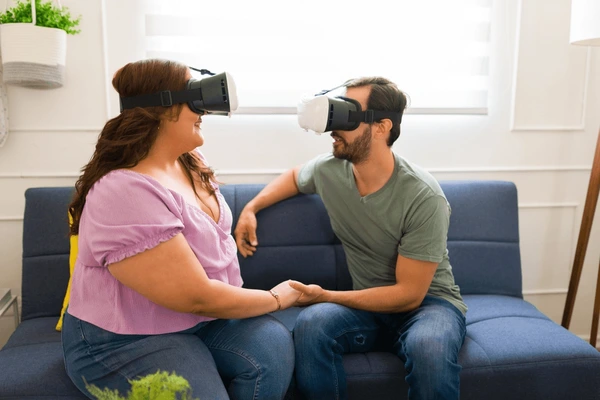
Virtual Intimacy: How Couples Use VR to Explore Fantasies Safely and Strengthen Trust
Virtual reality allows couples to explore fantasies without pressure, risk, or real-world consequences—creating emotional clarity, deeper trust, and honest connection before any physical step is taken.
Every long-term relationship contains curiosity. Fantasies arise naturally—from playful curiosity to deeper desires shaped by imagination, culture, and emotional needs. Yet acting on those fantasies in the real world often feels overwhelming. It can involve fear of jealousy, logistical complexity, social judgment, or simply uncertainty about what both partners truly want.
Virtual reality (VR) is quietly changing how couples navigate this space. Instead of forcing decisions prematurely, VR offers a controlled, private environment where partners can explore ideas, emotions, and boundaries together—without risk, pressure, or permanent consequences.
For many modern couples, VR is not about replacing intimacy. It’s about understanding it more honestly.

Why Fantasies Feel Risky in Real Life
Real-world fantasy exploration requires a high level of emotional readiness. Even couples with strong communication can struggle with questions like:
What if one of us enjoys it more than the other?
What if jealousy appears unexpectedly?
What if this changes how we see each other?
These concerns are valid. Fantasies often live in imagination because imagination feels safe. Acting them out can feel irreversible.
VR creates a middle ground—a way to explore desire without committing to action.
VR as a Safe Emotional Sandbox
Virtual reality environments allow couples to step into scenarios together while remaining emotionally and physically secure. The key advantage is control.
In VR experiences designed for couples:
Nothing happens unless both partners agree
The experience can be paused or stopped instantly
Partners remain present with each other, not separated
There are no real people involved—only simulations
This makes VR fundamentally different from real-world experimentation. It becomes a sandbox for emotional exploration rather than a leap into the unknown.
What Couples Explore in VR
Couples use VR to explore a wide spectrum of fantasies—many of which are more emotional than physical.
Common exploration themes include:
Flirtation dynamics: How it feels to be desired while remaining connected
Group atmospheres: Understanding comfort levels with attention or shared energy
Voyeuristic curiosity: Observing without participating
Romantic seduction scenarios: Reigniting excitement and novelty
Soft-swing concepts: Exploring openness without physical risk
Importantly, these experiences often reveal what couples don’t want just as clearly as what they do.
Emotional Rehearsal Before Real Decisions
One of VR’s most powerful benefits is emotional rehearsal.
In traditional fantasy discussions, couples rely on imagination and assumptions. VR replaces guessing with experience. Partners can notice:
Emotional reactions in real time
Moments of excitement or discomfort
Unexpected triggers or boundaries
Levels of trust and reassurance needed
After the experience, couples often debrief—talking openly about what felt good, what didn’t, and why. This reflection builds emotional literacy and mutual understanding.
Strengthening Trust Through Shared Exploration
Rather than creating distance, many couples report that VR exploration strengthens trust. Why?
Because it requires honesty.
When partners explore together, they must communicate clearly, check in emotionally, and respect each other’s limits. The process reinforces a core message: “We are navigating this as a team.”
For couples who struggle to talk openly about fantasies, VR can act as a neutral starting point—less intimidating than direct conversation, yet more revealing than abstract discussion.
Why VR Feels Less Threatening Than Real Life
VR removes several pressure points that often derail real-world exploration:
No social consequences: No friends, venues, or reputations involved
No permanence: Experiences end when the headset comes off
No comparison anxiety: No real people to compare oneself against
No rushed decisions: Couples move at their own pace
This allows curiosity to exist without fear. And curiosity, when handled gently, often leads to deeper intimacy rather than disruption.
VR Is Not About Escaping Reality
A common misconception is that VR encourages avoidance or replaces real connection. In practice, many couples experience the opposite.
VR becomes a tool for clarifying desire, not escaping responsibility. It helps partners understand whether a fantasy is:
Something they want to pursue
Something they only enjoy imagining
Something that reveals a deeper emotional need
Often, couples discover that the conversation sparked by VR matters more than the scenario itself.

Who Benefits Most from VR Exploration?
VR exploration tends to resonate with couples who:
Value emotional safety and consent
Are curious but cautious
Want clarity before action
Prefer shared experiences over solo exploration
Are navigating new relationship phases
It is especially useful for couples who feel “curious but not ready” for real-world experimentation.
The Future of Intimacy Is Thoughtful, Not Reckless
Technology often gets blamed for distancing people. But when used intentionally, VR can do the opposite—it slows things down.
Instead of impulsive decisions, couples gain insight. Instead of pressure, they gain perspective. Instead of secrecy, they gain shared language.
Fantasies do not demand immediate action to be meaningful. Sometimes, exploring them safely is what brings couples closer—emotionally, romantically, and psychologically.
FAQ Section
Is VR fantasy exploration safe for relationships?
Yes, when approached collaboratively and with clear communication. VR allows couples to explore curiosity without physical or social risks.
Does VR replace real intimacy?
No. Most couples use VR as a conversation starter and emotional tool, not a replacement for connection.
What if one partner feels uncomfortable?
VR allows instant stopping, pausing, and discussion—making it safer than many real-world scenarios.
Can VR help couples communicate better?
Absolutely. Many couples find it easier to talk about fantasies after experiencing them together virtually.
Is VR only for adventurous couples?
Not at all. It often benefits cautious couples who want clarity before taking any real-world steps.
Related Articles



Where Curiosity Turns Into Chemistry
A private community for open-minded adults who value honesty, connection, and clear intentions.
Join Free Today