 English
 Italiano
 Fran\xc3\xa7ais
 Svenska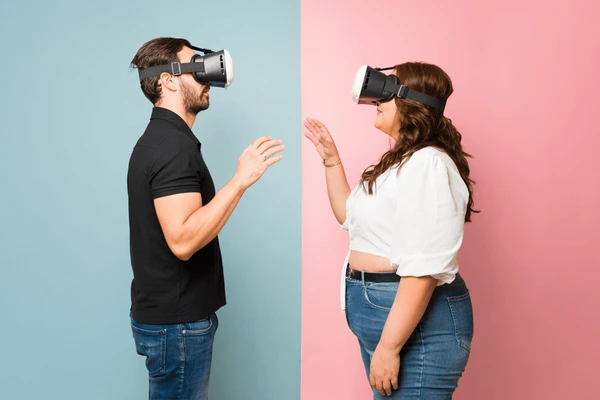
When Virtual Worlds Unlock Real Courage: How VR Gives People Permission to Be Themselves
Virtual reality doesn’t create confidence—it removes the fear that hides it. Discover how immersive environments unlock emotional courage, self-expression, and social confidence in people who thought they had none.
For decades, confidence has been treated like a personality trait—something you’re either born with or doomed to lack. Shy people are told to “come out of their shell.” Introverts are encouraged to “fake it till they make it.” Social anxiety is framed as a personal flaw.
But virtual reality tells a different story.
Inside immersive VR social environments like SwingersNest VR lounges, people who once believed they were awkward, invisible, or uninteresting experience something unexpected: emotional courage. Not the loud, performative kind—but the quiet bravery of speaking freely, flirting naturally, and expressing identity without fear.
VR doesn’t manufacture confidence.
It removes the pressure that was suppressing it.
And when the pressure disappears, courage emerges.

The Hidden Truth About Shyness and Confidence
Most people who identify as “shy” aren’t lacking personality or desire for connection. They’re responding rationally to environments that feel unsafe, overstimulating, or judgmental.
Real-world social spaces are full of invisible stressors:
Constant eye contact
Immediate physical judgment
Noise, crowding, and interruptions
Fear of rejection in real time
Social scripts that punish hesitation
Human psychology doesn’t thrive under pressure—it contracts.
Virtual environments change the equation.
By design, VR reduces social threat while increasing emotional presence, creating the psychological safety necessary for authentic self-expression.
This is why so many users describe VR as the first place they felt brave.
Psychological Safety: The Engine of Emotional Courage
At the core of emotional growth through VR is psychological safety—the feeling that you can express yourself without fear of embarrassment, rejection, or punishment.
In virtual reality:
Avatars soften physical self-judgment
Distance feels intentional, not rejecting
Silence feels comfortable, not awkward
Conversation unfolds without interruption
Presence is focused, not chaotic
These factors dramatically reduce social anxiety triggers.
The brain interprets the environment as safe. When the nervous system relaxes, personality expands.
This is why users say things like:
“I didn’t know I could talk like that.”
“I felt brave for the first time.”
“People actually listened to me.”
Not because VR changed who they were—but because it stopped suppressing who they already were.
VR Identity Exploration: Becoming Without Pretending
One of the most misunderstood aspects of avatar-based communication is the idea that people are “hiding.”
In reality, avatars often reveal more than physical bodies ever could.
Virtual identity exploration allows users to:
Express flirtation without fear
Experiment with tone, pacing, and confidence
Speak without worrying about facial micro-judgment
Explore desire, curiosity, and attraction safely
This isn’t deception. It’s emotional permission.
When someone no longer fears being judged for their appearance, voice, or timing, they communicate more clearly. Their humor sharpens. Their curiosity opens. Their confidence grows organically.
VR doesn’t give people courage.
It gives them permission to access it.
Why Shy People Thrive in Virtual Worlds
Search data consistently shows rising interest in:
how VR helps shy people
virtual reality for introverts
overcoming social anxiety in VR
VR social confidence
And the reason is simple: environment shapes behavior.
In immersive virtual spaces:
Social pressure is lowered
Control over engagement is restored
Emotional pacing feels natural
Rejection feels less personal
Expression feels safer
This creates what psychologists call environment-driven personality expression—where traits emerge based on context, not fixed identity.
The same person who freezes in a crowded bar may flourish in a virtual lounge designed for intimacy, calm lighting, and intentional interaction.
Flirting, Attraction, and Emotional Safety in VR
Flirting in virtual reality isn’t about explicit behavior—it’s about emotional calibration.
VR environments support:
Eye contact without intimidation
Playful conversation without stakes
Attraction without immediate consequence
Curiosity without pressure
This is why virtual dating environments often feel more emotionally rich than real-life encounters. They prioritize presence over performance.
In spaces like SwingersNest VR lounges, users report:
Deeper conversations
Slower, more meaningful attraction
Increased self-esteem
Stronger emotional bonding
Because when anxiety fades, connection deepens.
Emotional Permission Theory (Implicit but Powerful)
There’s an unspoken principle at work here—what could be called emotional permission theory.
People don’t need to be taught confidence.
They need permission to express it.
Virtual environments provide that permission by:
Removing immediate judgment
Allowing controlled vulnerability
Encouraging curiosity over performance
Supporting emotional safety
The result isn’t escapism.
It’s emotional empowerment.
Over time, users often carry this confidence back into the real world—proof that VR isn’t replacing reality, but rewiring how people relate to themselves.

VR as a Tool for Emotional Growth
Far from being a novelty, virtual reality is becoming a psychological training ground for:
Social confidence
Emotional expression
Identity exploration
Relationship skills
Self-esteem development
As immersive environments evolve, they’re teaching us something essential:
Courage is not a trait.
It’s a response to safety.
And VR is exceptionally good at creating safety.
Frequently Asked Questions (FAQ)
Does virtual reality really help with social anxiety?
Yes. VR reduces common anxiety triggers like immediate judgment, overstimulation, and social pressure, allowing users to communicate more freely.
Why do people feel braver in virtual worlds?
Because virtual environments create psychological safety. When fear decreases, emotional courage naturally emerges.
Is confidence in VR fake?
No. Studies and user experiences show that confidence developed in VR often transfers into real-life interactions.
How do avatars affect self-expression?
Avatars reduce appearance-based anxiety and allow people to focus on communication, tone, and emotional connection rather than self-consciousness.
Can introverts benefit from VR social spaces?
Absolutely. Virtual lounges are often designed for calm, intentional interaction—ideal for introverts and reflective personalities.
Related Articles


Where Curiosity Turns Into Chemistry
A private community for open-minded adults who value honesty, connection, and clear intentions.
Join Free Today